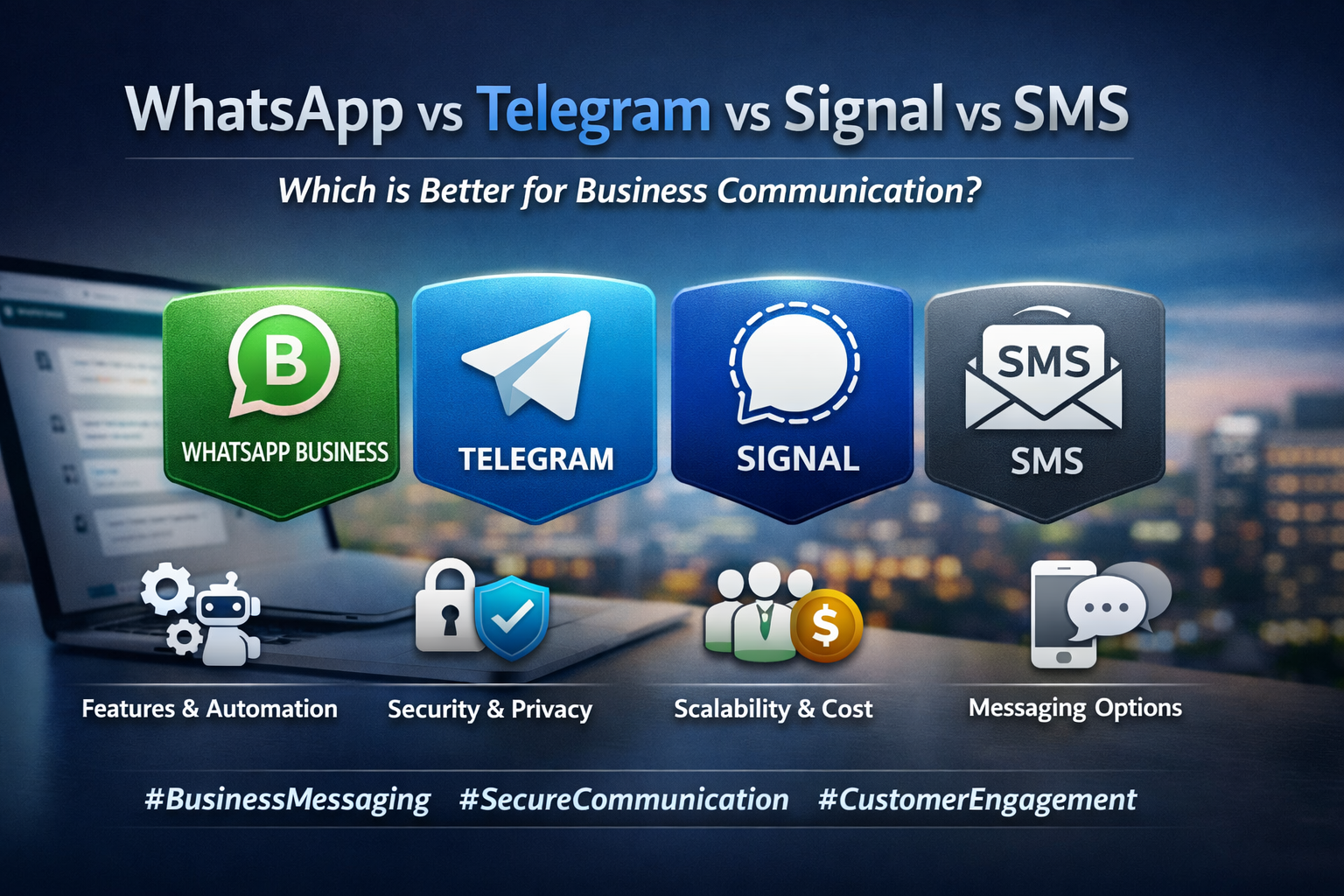
In today’s fast-moving digital world, effective business communication has become more important than ever. Whether you’re managing customer queries, promoting products, or sharing updates, your messaging platform can shape your customer relationships.
Among the top tools for business communication, WhatsApp vs Telegram Business stand out. Both offer automation, personalization, and scalability, but they operate differently. While WhatsApp Business is known for its wide user base and trust factor, Telegram Business attracts companies looking for flexibility, cloud access, and large-scale engagement.
This article compares WhatsApp vs Telegram Business, helping you understand their key features, security, automation, and costs. We’ll also briefly touch on SMS and Signal alternatives to give you a complete picture of modern messaging options for business.
Key Features Comparison: WhatsApp vs Telegram Business
When it comes to features, both WhatsApp and Telegram cater to business needs, but their focus differs.
WhatsApp Business:
- Business Profiles: Businesses can create verified profiles with an address, description, website, and contact details.
- Catalogs & Quick Replies: Showcase products directly in chats and use quick replies to save time.
- Broadcast Lists & Labels: Send updates to multiple users and organize chats efficiently.
- Automation: Through the WhatsApp Business API, brands can automate messages, set away responses, and manage leads effectively.
Telegram Business:
- Cloud-Based Storage: Telegram allows unlimited cloud storage, so messages and files never disappear.
- File Sharing: Supports files up to 2GB, much higher than WhatsApp’s limit.
- Channels & Groups: Telegram supports up to 200,000 members, perfect for large communities.
- Bots & Customization: Telegram’s Bot API enables advanced automation, including payment processing and customer support.
WhatsApp Business is ideal for personalized customer service and verified interactions, while Telegram Business offers superior scalability and flexibility for larger audiences.
Security and Privacy: WhatsApp Signal vs Telegram Signal
Security is a top concern for any business. Here’s how the two compare in terms of privacy and encryption, also touching on WhatsApp Signal vs Telegram Signal concepts.
WhatsApp Business:
WhatsApp uses Signal protocol encryption, meaning all messages, calls, and media are end-to-end encrypted by default. This ensures that only the sender and receiver can read the messages, not even WhatsApp itself.
Telegram Business:
Telegram offers optional end-to-end encryption through its “Secret Chats” feature. Regular chats are stored on the cloud and encrypted during transfer, but can be accessed from multiple devices.
Signal Protocol Comparison:
- WhatsApp Signal: Uses the original Signal protocol for all chats by default.
- Telegram Signal: Does not use the Signal protocol; instead, it relies on its own MTProto encryption.
When comparing WhatsApp Signal vs Telegram Signal, WhatsApp provides stronger privacy by default, while Telegram offers flexibility and multi-device access at the cost of slightly less security.
Messaging Modes: WhatsApp SMS vs Telegram SMS
Many businesses wonder whether to use internet-based messaging apps or stick with traditional SMS. Let’s break it down.
WhatsApp SMS vs Telegram SMS Comparison:
- WhatsApp SMS: WhatsApp requires internet but delivers instant, rich messages, with images, videos, catalogs, and payment links.
- Telegram SMS: Telegram operates similarly, utilizing the internet for fast delivery, with added advantages such as file sharing and group broadcasts.
- Traditional SMS: Works without internet but is limited to text-only communication and has lower engagement.
Reliability & Engagement:
- SMS: Universal reach, especially in areas with poor connectivity.
- WhatsApp & Telegram: Higher engagement, better analytics, and multimedia communication.
Use SMS for essential notifications or areas with limited internet connectivity. Use WhatsApp or Telegram for interactive, real-time communication and customer engagement.
Automation and Integration for Business Communication
Automation is where both WhatsApp and Telegram shine, but in very different ways.
WhatsApp Business API:
The WhatsApp Business API supports automation tools like chatbots for:
- Lead generation
- Order confirmations
- Automated replies and follow-ups
It also integrates with CRM systems (like HubSpot or Zoho CRM), marketing tools, and customer support software, making it powerful for structured business operations.
Telegram Bot API:
Telegram’s open-source Bot API allows developers to build advanced automation without strict limitations.
You can create bots for:
- Automated FAQs
- Payment collection
- Lead nurturing
- Personalized notifications
If your focus is on customer service and verified communication, WhatsApp Business API is the way to go. If you want creative automation and open integration, Telegram’s Bot API is more flexible and cost-effective.
Scalability and Cost Considerations
When comparing WhatsApp Business vs Telegram Business, scalability and pricing are key factors.
WhatsApp Business:
- Free for small businesses using the mobile app.
- The Business API has usage-based pricing, depending on the number of conversations.
- Groups are limited to 1,024 members.
Telegram Business:
- Entirely free, even for large audiences.
- Supports massive groups and channels (up to 200,000 members).
- Businesses can use bots to broadcast messages to thousands instantly.
For startups or large communities, Telegram offers unbeatable scalability at zero cost. For businesses needing verified, one-to-one communication, WhatsApp Business API justifies the cost through credibility and control.
Choosing the Best Option for Your Business Needs
So, which is better, WhatsApp Business or Telegram Business? The answer depends on your goals, audience, and communication style.
If You’re a Small or Local Business:
- Choose WhatsApp Business for its ease of use, customer trust, and professional tools like catalogs and quick replies.
- Integrate SMS for fallback messaging in areas with low internet connectivity.
If You’re a Large Enterprise or Community Brand:
- Choose Telegram Business for its scalability, automation flexibility, and open API.
- Use Telegram Bots for lead generation, updates, and community management.
If Privacy Is Your Top Priority:
- Use WhatsApp for end-to-end encryption by default.
- Or explore Signal, which focuses purely on privacy and security for sensitive communications.
Balanced Strategy:
For a holistic communication setup, combine these tools:
- WhatsApp Business for direct engagement
- Telegram Business for broadcasts and community updates
- SMS for transactional messages
- Signal for private or internal team conversations
This multi-channel strategy ensures better customer reach, security, and engagement.
FAQ: WhatsApp Business vs Telegram Business
Which is better for automation?
Telegram’s Bot API is more flexible, but WhatsApp Business API offers structured and secure automation.
Which platform is safer for businesses?
WhatsApp offers stronger encryption (Signal protocol) by default, making it more secure for confidential communication.
Can I use both WhatsApp and Telegram for business?
Yes, using both can help you target different audiences: WhatsApp for personalized chats, Telegram for community updates.
What’s the main difference between WhatsApp SMS and Telegram SMS?
Both rely on the internet, unlike regular SMS. WhatsApp is better for verified communication, while Telegram excels in content sharing.